
100 Questions

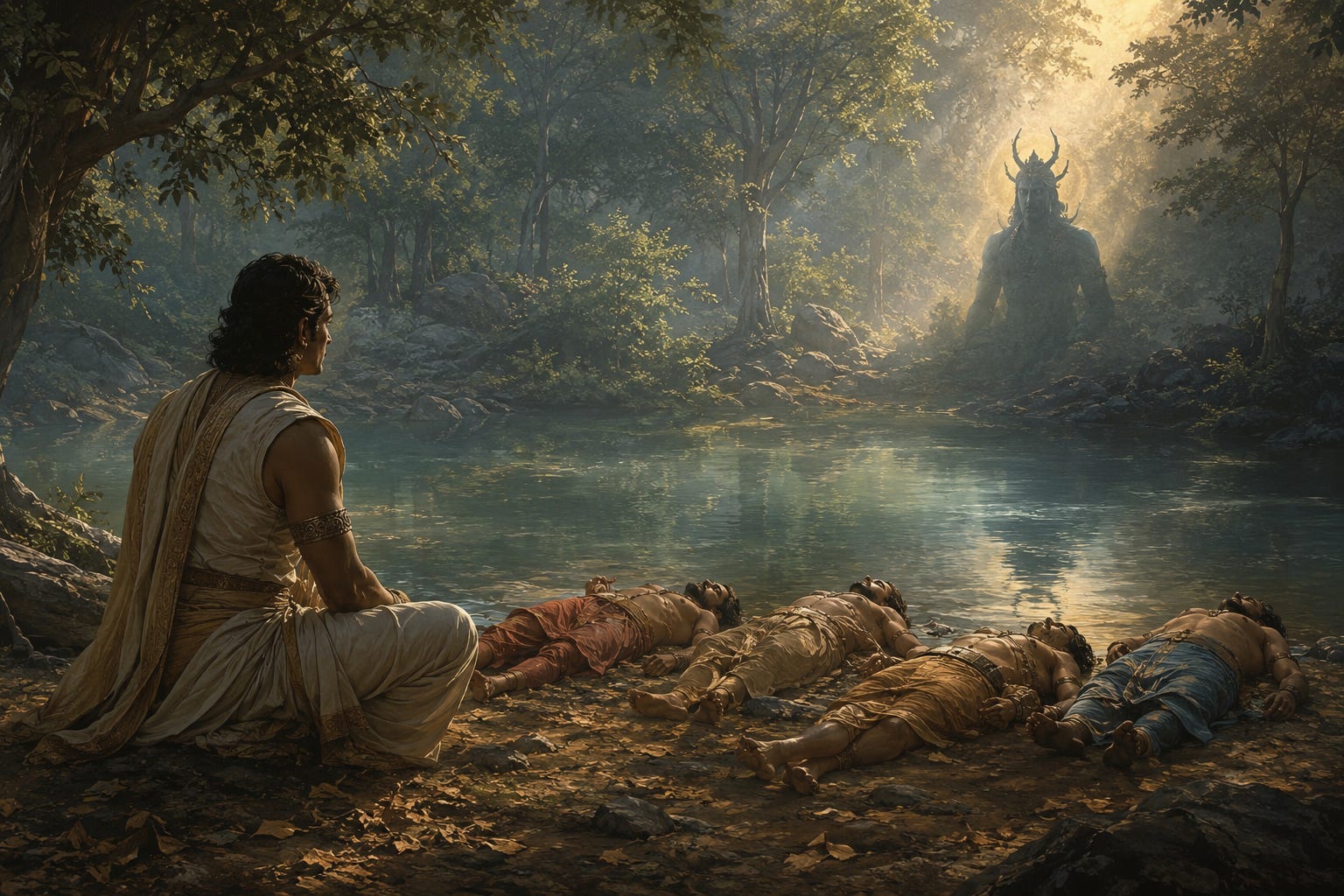
There is a story in the Mahābhārata, one of the great epics of India, that lingers long after you finish reading it. A story about death. About wisdom. About the strange way human beings live as though life will go on forever.
The five Pāṇḍava brothers are deep in exile, wandering far from the kingdom that was once theirs. The days stretch long beneath the heat. Dust clings to their skin. Clothes hang heavy with sweat. Hunger sharpens quickly, but thirst sharpens faster.
On this particular day, the thirst becomes unbearable.
Yudhiṣṭhira, the oldest brother, sends one of his other brothers ahead to search for water. He disappears through tangled trees and dry earth until eventually the air begins to cool. Somewhere nearby, water.
Then suddenly, through the forest, he sees it. A lake. As still as polished glass. The pale afternoon sky rests across its surface without distortion, disturbed only by the slow drift of a fallen leaf. After hours beneath the heat, the water looks impossibly cold.
He rushes toward it. But just as he reaches the edge, a voice cuts through the silence.
“Do not drink from this lake until you have answered my questions.”
The brother startles and looks around, searching the trees. But the thirst inside him is louder than caution. He kneels quickly, cups the water in his hands, drinks deeply, and then collapses beside the lake.
When he does not return, another brother goes searching. He too finds the water. He too hears the warning. And he too drinks. And falls.
One after another the brothers arrive then fall.
Bhīma, powerful and fearless, who moved through the world as though nothing could overcome him.
Arjuna, sharp-eyed and disciplined, the great archer whose focus rarely wavered.
Nakula and Sahadeva, the twin brothers who had endured every hardship side by side.
One after another, they ignore the unseen voice. One after another, they kneel beside the water. One after another, they fall silent. Until only Yudhiṣṭhira remains.
When he finally reaches the lake, he does not rush forward. He sees them immediately. Four bodies lying motionless along the water’s edge.
For a moment, everything inside the forest seems to stop. The cicadas fall silent. Even the wind seems to withdraw into the trees.
Yudhiṣṭhira’s brothers lie scattered beside the lake like abandoned garments. Then the voice speaks again.
“This lake belongs to me. Answer my questions before you drink, or you too will fall.”
Yudhiṣṭhira stands very still. And listens.
The voice belongs to a Yaksha, a mysterious being of the forest. Ancient. Watchful. More presence than form. And so the questions begin.
Some traditions say there were a hundred questions asked beside that lake.
Questions about duty. About suffering. About virtue. About desire. Questions that seem less concerned with intelligence than with the shape of a person’s character.
Yaksha asks:
“What makes a person wise?”
Yudhiṣṭhira answers:
“Not learning alone. Wisdom grows through keeping company with the wise.”
The lake remains perfectly still.
Yaksha asks:
“What is the greatest wealth?”
“Contentment,” Yudhiṣṭhira replies. “Contentment is the greatest wealth.”
Yaksha asks:
“What is the highest dharma?”
Yudhiṣṭhira replies:
“Compassion toward all beings.”
Yaksha asks:
“What moves faster than the wind?”
Yudhiṣṭhira answers:
“The mind.”
The questions continue.
The forest itself remains suspended around them. The brothers remain motionless beside the water while the unseen Yaksha asks about life and death as though they are not separate things at all.
Then finally, the Yaksha asks:
“What is the greatest wonder?”
For a long moment, Yudhiṣṭhira says nothing. He looks at the still water. At the silent forms of his brothers lying beside it. At the unbearable fragility of everything human.
And then he answers:
“Day after day, countless beings go to the abode of death, yet those who remain live as though they themselves are immortal. What could be more wondrous than this?”
The forest offers no reply. But something shifts. The Yaksha is satisfied. Yet there is one final test. He tells Yudhiṣṭhira that one brother may return to life. Only one.
Beside the lake lies Bhīma, whose strength could protect him through exile and war.
Arjuna, whose skill with the bow might help reclaim their kingdom.
Nakula and Sahadeva, the sons of Mādrī.
Yudhiṣṭhira does not look toward Bhīma. He does not turn toward Arjuna. His gaze rests quietly on Nakula.
The Yaksha is surprised.
“Why Nakula? Why not the brother whose strength could keep you alive? Why not the warrior whose skill could secure victory?”
Yudhiṣṭhira answers with quiet steadiness:
“Our father had two wives: Kuntī and Mādrī. Kuntī still has one living son in me. Mādrī should also have one son restored. Let Nakula live.”
Even here, standing beside death itself, he remembers another mother’s grief. And because of this, the Yaksha restores them all.
Bhīma breathes sharply, as though surfacing from deep water. Arjuna stirs against the earth. Nakula and Sahadeva open their eyes.
Life returns slowly to the edge of the lake. Then the Yaksha reveals himself not merely as a spirit of the wilderness, but as something aligned with dharma itself. With truth. With the deeper order beneath things.
And just as suddenly as it began, the moment passes. The forest exhales. The brothers gather themselves. And the journey continues.
There is something about this story that stays with me long after it ends. Not only Yudhiṣṭhira’s answer, but the recognition beneath it.
Death is never really distant. Not abstract. Not reserved for other people. It walks quietly beside life at all times, even when we refuse to look directly at it. And still, somehow, we live as though there will always be more time.
Another season. Another conversation. Another ordinary morning.
The people we love leave cups in the sink. Send half-finished messages. Say things like, “I’ll call you tomorrow.”
Most days pass without us noticing how fragile they really are. Perhaps we should be asking ourselves, how would live this day if it was your last?
So beautiful xxx life is so fragile and yet we live like we are immortal ❤️
I was moved by that story !